
Human Functioning™Volume 1 · Issue 4
Have You Been Mentally Masturbating?
There is a kind of thinking that feels deep but changes nothing. The question is not merely what you understand, but what your understanding has produced.

Dr. Cheryll Holmes, PhD, PsyD
Founder and Professor of Relationship Science and Human Functioning™
September 13, 2026
9 min readGeneral Readership
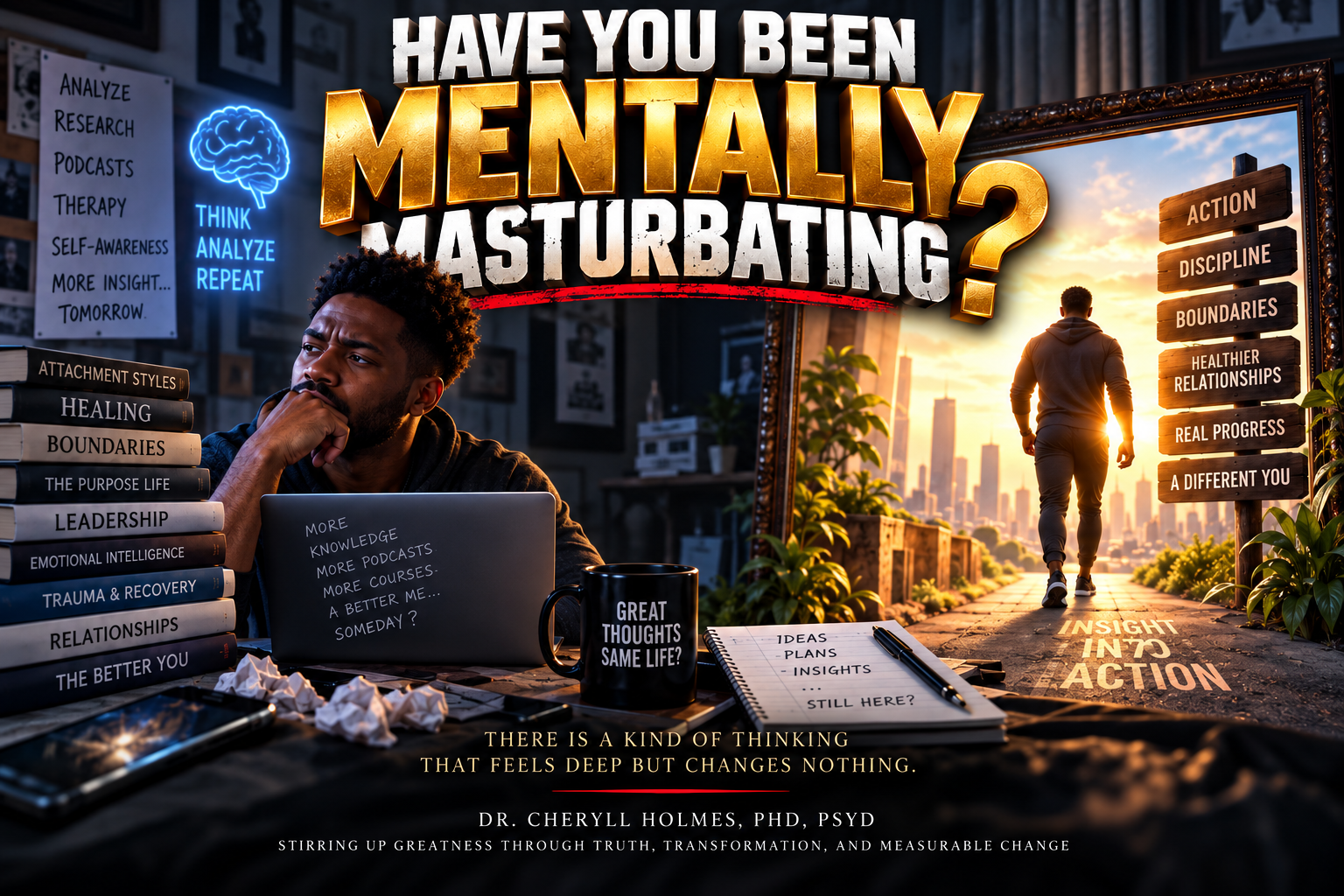
There is a kind of thinking that feels deep but changes nothing. The question is not merely what you understand, but what your understanding has produced.
I know, I know, you're like what is Dr Holmes talking about?
But, there is a kind of thinking that feels deep but changes nothing.
It gives you the sensation of doing psychological work without requiring you to make a psychological sacrifice. It allows you to analyze your childhood, name your attachment style, identify your triggers, explain your partner’s behavior, discuss your purpose, quote your therapist, underline another book, and listen to another podcast.
Yet your life remains untouched by everything you know.
That is what I call mental masturbation.
It is not a clinical diagnosis. It is a deliberately uncomfortable metaphor for using thought to stimulate yourself without allowing that thought to produce transformation.
You experience the temporary satisfaction of insight, but nothing is conceived from it.
No decision.
No changed boundary.
No difficult conversation.
No apology.
No completed assignment.
No financial discipline.
No new relational behavior.
No measurable movement.
You feel as if you have done something because your mind has been busy. But mental activity and personal movement are not the same thing.
Intelligence Can Become an Elaborate Hiding Place
Highly intelligent and deeply self-aware people may be especially vulnerable to this trap.
Why?
Because they can explain almost anything.
They can construct a psychologically sophisticated explanation for why they are afraid, why they procrastinate, why they remain in a destructive relationship, why they have not launched the business, why they keep selecting the same kind of partner, or why they continue repeating a behavior they claim to have outgrown.
The explanation may even be accurate.
But accuracy does not automatically produce transformation.
Sometimes knowledge helps us confront the truth. At other times, knowledge becomes the curtain behind which we hide from it.
We learn the language of healing without submitting to the demands of healing. We become fluent in the vocabulary of boundaries while remaining unwilling to disappoint anyone. We study leadership while avoiding accountability. We discuss forgiveness while privately feeding the offense. We announce that we are “working on ourselves” when we are actually studying ourselves from a safe emotional distance.
The mind becomes a courtroom in which we serve as the attorney, witness, jury, and judge. We introduce evidence, challenge motives, replay conversations, and deliver closing arguments.
Then we return to the same life.
Self-Reflection and Insight Are Not the Same Thing
Psychological research makes an important distinction between examining yourself and actually understanding yourself.
Grant, Franklin, and Langford’s research on self-reflection and insight treated them as separate psychological processes. A person can spend considerable time examining thoughts and feelings without gaining the clarity required for self-regulation and behavioral change.
That distinction is critical.
Thinking about yourself is not necessarily understanding yourself.
Understanding yourself is not necessarily confronting yourself.
Confronting yourself is not necessarily changing yourself.
You can possess insight and still protect the behavior that the insight exposed.
Research on repetitive thought reaches a similar conclusion. Repetitive thinking is not automatically harmful or helpful. Its value depends on its content, context, and the way a person processes the experience. It can support planning and problem-solving, or it can become abstract, circular, and emotionally immobilizing. Psychologist Edward Watkins describes this important difference in his review of constructive and unconstructive repetitive thought.
Therefore, the question is not simply, “Have I been thinking about this?”
The better question is, “What has my thinking produced?”
The Emotional Payoff of Thinking Without Acting
Mental masturbation survives because it gives us several emotional rewards.
First, it gives us the illusion of progress. Learning something new produces movement inside the mind, even when no movement has occurred in life.
Second, it protects us from exposure. Thinking about making the telephone call is safer than making it. Studying boundaries is safer than setting one. Planning the book is safer than allowing someone to read the first chapter.
Third, it preserves our fantasies. As long as the dream remains inside our heads, it cannot fail, be criticized, or prove more difficult than we imagined.
Fourth, it allows us to maintain a flattering identity. We can continue seeing ourselves as insightful, gifted, called, or misunderstood without submitting those beliefs to measurable evidence.
This is why mental masturbation is not simply excessive thinking. It is thinking that performs a protective function.
It helps us avoid the cost of becoming.
Five Signs That Your Thinking Has Become Self-Stimulation
You keep asking questions whose answers you already know.
You are no longer searching for clarity. You are hoping to discover an answer that will not require courage.
You repeatedly consume new information without applying what you previously learned.
You do not need another book, sermon, podcast, course, or conversation. You need to obey the truth already sitting in your notes.
You can describe your pattern more clearly than you can demonstrate your progress.
Your language has changed, but your conduct has not.
You confuse emotional intensity with transformation.
Crying about something, praying about it, journaling about it, or speaking passionately about it may be meaningful. However, emotional release is not always behavioral change.
You use complexity to avoid a simple decision.
Some circumstances are genuinely complicated. Others become complicated because the obvious answer is expensive. It may cost comfort, approval, familiarity, pride, money, access, or the relationship itself.
Sometimes the answer is difficult, but it is not unclear.
A Necessary Word of Compassion
Not every failure to act is mental masturbation.
Depression can diminish energy and motivation. Trauma can make an ordinary decision feel dangerous. Anxiety can distort risk. Grief can slow psychological processing. Executive-function difficulties can interfere with planning, initiation, and completion. A person in an unsafe or controlling environment may need protection and strategic support before taking visible action.
We must never use provocative language to shame someone whose nervous system, mental health, or circumstances have restricted their capacity.
The issue is not that every person must move quickly.
The issue is whether thinking is helping the person move responsibly, or helping the person avoid movement indefinitely.
Compassion should help us tell the truth more safely. It should not require us to stop telling it.
Our Community Belief
In this community, we do not confuse information with transformation.
We do not celebrate the ability to name a pattern while continuing to protect it.
We do not collect insights merely to sound evolved.
We believe that insight has not completed its assignment until it enters our decisions, relationships, habits, leadership, stewardship, and daily conduct.
Our enemy is not ignorance alone.
Our enemy is unconverted insight: truth that entered the mind but was never permitted to alter the life.
This does not mean every insight must produce an immediate dramatic decision. Some truths require careful discernment, emotional regulation, safety planning, wise counsel, and strategic timing.
But healthy processing has direction.
Avoidance has repetition.
The 24-Hour Conversion Rule
Whenever you receive an insight that genuinely applies to your life, convert it into one observable action within 24 hours.
Not an entire life transformation. One honest action.
Use these five questions:
What truth did I recognize?
What behavior is this truth asking me to change?
What discomfort have I been avoiding?
What is one safe, measurable action I can take within 24 hours?
What evidence will demonstrate that I completed it?
For example:
“I recognize that I have been complaining about feeling unappreciated while refusing to communicate what I need.”
The converted action might be:
“Before 7:00 p.m. tomorrow, I will ask my spouse for a 20-minute conversation and clearly describe one need without accusation.”
That is no longer merely insight. It has become an implementation intention: a specific decision connecting an anticipated situation with a concrete response. Research on these “if-then” plans has found that they can meaningfully improve the likelihood of goal attainment across many kinds of behavior (Gollwitzer and Sheeran).
The action does not have to be enormous. It has to be real.
Do Not Ask What You Learned Until You Ask What You Did
We have created a culture that rewards people for consuming information.
How many books have you read?
How many conferences have you attended?
How many sermons have you heard?
How many courses have you completed?
Those questions measure exposure. They do not necessarily measure development.
A better set of questions would be:
What did you stop doing?
What conversation did you finally have?
What boundary did you establish?
What did you repair?
What did you complete?
What truth changed the way you behaved when no one was watching?
The final evidence of learning is not what you can repeat.
It is what your life can now reveal.
Scripture expressed this problem long before psychology gave us language for rumination, avoidance, and self-regulation: hearing truth without doing it creates self-deception.
We can become so impressed by what we understand that we fail to notice what we have refused to change.
Your Assignment
Before you leave this post, identify one truth you have been thinking about but have not converted into action.
Complete this sentence:
“I already know __________, but I have avoided acting on it because __________. Within the next 24 hours, I will __________.”
Do not give us a performance.
Give us evidence.
We are not building a community of people who merely sound insightful. We are becoming people whose knowledge can be seen in the quality of our decisions, relationships, leadership, and lives.
Thinking should not merely stimulate you.
It should eventually transform you.
Please leave a like or comment and bring your friends over to our reading room- that would be super encouraging
Dr. Cheryll Holmes, PhD, PsyD Stirring Up Greatness Through Truth, Transformation, and Measurable Change
References
References are recorded with the manuscript and published with the article.
Estimated citation
Holmes, C. (2026). Have You Been Mentally Masturbating?. Human Functioning™, 1(4). Holmes Knowledge Center, Holmes Training Academy™.